
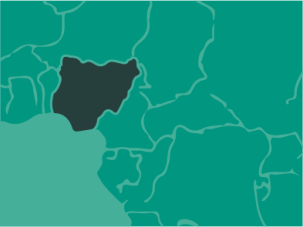






For Nigerian women and girls, patriarchal norms, rampant violence, and poverty are obstacles they encounter in their daily lives.
Nigeria is Africa’s most populous country, but rising instability, cash scarcity, a weakening economy, and distrust of government is threatening its progress.
- 46% of Nigeria's population lives below the international poverty line.
- 60% of girls are absent from secondary school.
- 3.4 million people are internally displaced — most of them women and children.
Localized violence, spurred by farmer-herder violence, armed banditry, and Boko Haram, compromises the safety of women and girls, subjecting them to dangers like sexual assault and forced early marriage.
“We were taken unawares on our way to the farm, and before we could raise an alarm, some of us were killed...on returning to the community, I found out that my house had been razed to the ground and corpses littered everywhere.”
-Nvou, SWSN Participant
Our Work
Through solidarity and opportunities provided through our programs, marginalized Nigerian women are bolstering their confidence and skills to face gender inequality and transform their lives, families, and communities.
Our flagship Stronger Women, Stronger Nations (SWSN) program in the Plateau and Bauchi states breaks the isolation of living in a high-risk environment by placing women in groups of 25. By developing vocational skills, learning how to run a business, and how to earn and save money, SWSN participants use their power to transform their lives. In addition to their training for economic independence, they also receive instruction on their rights and reproductive health.
"If not for my revelations through attending the training, [my girls] would have been subjected to the same violations my mother and I went through.”
-Amos, Program Participant, Nigeria
Change Agents

The Change Agents program in Nigeria teaches graduates of our Stronger Women, Stronger Nations program how to become advocates in their communities.
As Change Agents, they champion their rights, provide health referrals, and learn how to prevent domestic violence and abuse.
Even though equal rights in Nigeria are constitutional, customary laws prioritize boys’ education over girls. Change Agents in Nigeria’s Bauchi State have successfully navigated this challenge by establishing a primary school that welcomes both boys and girls , accounting for nearly half of the 92 students who joined on the first day of class.
Their advocacy is contributing to building the next generation of Change Agents by supporting girls to achieve their dreams.
Men's Engagement Program
WfWI’s Men’s Engagement Program (MEP) was originally spearheaded through the work of the Nigeria team and has since expanded to our other country offices. To supplement our goal to enable an environment which fully acknowledges women’s rights, the program was established to engage men as allies, where they better understand gender equality and women’s rights.
"I now have a good understanding of women’s rights. I love, respect and treat my wife with dignity that she deserves."
-Amos, MEP participant
The Impact
-
Since its inception in 2000, our signature program Stronger Women, Stronger Nations has reached a total of 114,652 Nigerian women and girls.
-
5,743 women and girls served by SWSN program in 2025.
-
Women more than doubled their monthly earnings, increasing from $10.21 to $26.53.
-
At graduation, 83% of women were actively involved in decisions about their lives and households, up from just 36% at enrollment.
-
Despite economic challenges, 100% of participants were setting aside personal or household savings, compared to only 39% when they joined the program.
-
Women also gained a stronger understanding of women’s and girls’ rights in their national context, with knowledge increasing from 55% to 92%.
-
Most notably, women’s self-efficacy scores nearly doubled, rising from an average of 46 to 92 on a 0–100 scale.
-
Since inception, our local team has reached 17,567 men through our Men’s Engagement Program.


